ESBMC
esbmc.h, concurrency soundness fixes and more. Read the
development update.ESBMC is a mature, permissively licensed open-source SMT-based context-bounded model checker for single and multi-threaded C, C++, CUDA, CHERI, Kotlin, Python, Rust, and Solidity programs. It automatically detects or proves the absence of runtime errors (e.g., bounds checks, pointer safety, overflow) and verifies user-defined assertions without requiring pre- or postconditions. For multi-threaded programs, ESBMC supports lazy and schedule-recording approaches, encoding verification conditions into SMT formulas solved directly by an SMT solver.
Download
Features
ESBMC aims to support all C features up to version 14, and detects errors in software by simulating a finite prefix of the program execution with all possible inputs. Classes of problems that can be detected include:
- The Clang compiler as its C/C++/CHERI/CUDA frontend;
- The Soot framework via Jimple as its Java/Kotlin frontend;
- The ast and ast2json modules as its Python frontend; the first SMT-based bounded model checker for Python programs;
- Implements the Solidity grammar production rules as its Solidity frontend;
- Supports IEEE floating-point arithmetic for various SMT solvers.
ESBMC implements state-of-the-art incremental BMC and k-induction proof-rule algorithms based on Satisfiability Modulo Theories (SMT) and Constraint Programming (CP) solvers.
We provide some background material/publications to help you understand what ESBMC can offer. These are available online. For further information about our main components, check the ESBMC architecture.
SV-COMP History
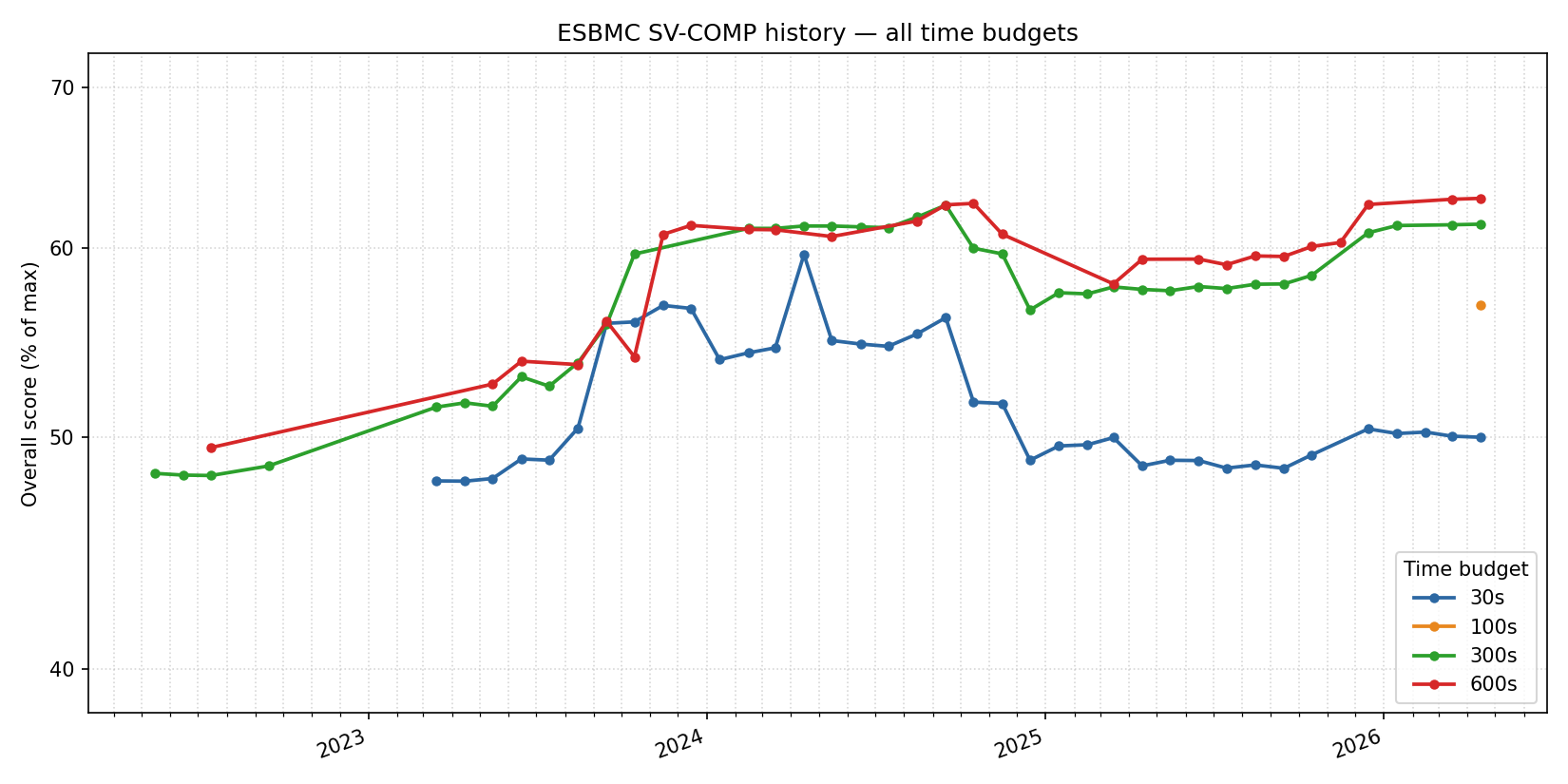
Overall SV-COMP score over time, by per-benchmark time budget.
Applications
ESBMC has been used in a broad range of cutting-edge applications across multiple domains. If you applied ESBMC in your research, but it is not mentioned below, please, do not hesitate to contact us through our GitHub repository.
CBMC Differences
ESBMC and CBMC share a common ancestry but have diverged substantially. The list below reflects the current state of ESBMC (release 7.x) and contrasts it with mainline CBMC.
Frontends and language support.
- ESBMC uses the Clang/LLVM front-end for C (up to C23), C++ (up to C++20), CUDA
and CHERI-C, inheriting Clang’s diagnostics, attribute handling and template
instantiation. CBMC still relies on its own in-tree C and C++ parsers, which
lag behind Clang on modern language features (e.g. C++17/20 templates,
structured bindings,
if constexpr). - ESBMC ships dedicated frontends for Python 3.10+ (the first BMC-based Python-code verifier), Solidity (smart contracts) and Kotlin/Java (via the Soot/Jimple IR), with ongoing work on a Rust frontend. CBMC supports only C/C++ in the main tool; Java is handled by the separate JBMC project and Rust by Kani.
Verification backend.
- ESBMC encodes programs directly into SMT and supports multiple solver backends — Z3, Bitwuzla (default), Boolector, CVC4/CVC5, Yices, MathSAT and any SMT-LIB v2 solver — exploiting native theories for arrays, bit-vectors, floating-point and quantifiers. CBMC focuses on SAT-based encodings of fully unrolled programs (its built-in solver is based on MiniSat), with external SMT solvers used in a more limited role.
- ESBMC integrates an interval-arithmetic abstract domain that can prune loop
unwindings (
--interval-symex-guard) and discharge assertions proved true by the abstract semantics (--interval-symex-assert), reducing the size of the SMT formula handed to the solver.
Proof techniques.
- ESBMC implements incremental BMC, k-induction and bidirectional k-induction in a single invocation, combining base-case, forward-condition and inductive-step checks in one run. CBMC’s k-induction workflow historically requires three separate passes (CFG construction, program annotation, verification) and lacks the forward condition needed to prove that all reachable states have been covered, relying on bounded unwinding instead.
- ESBMC supports function contracts (
__ESBMC_assume,__ESBMC_assert, pre/post-conditions) and LLM-assisted invariant generation for loops that cannot be unrolled within a budget.
Concurrency verification.
- ESBMC explores thread interleavings explicitly under context-bounded verification, with both lazy and schedule-recording exploration strategies and a partial-order reduction (POR) pass that prunes independent interleavings. This typically scales better than CBMC’s single-formula encoding of the whole concurrent program on programs with many interleaving points.
- ESBMC ships models for POSIX threads, C11 atomics and a subset of
std::thread/std::atomic, and can verify safety, deadlock and data-race properties.
Memory safety and floating-point.
- A byte-precise memory model with object-level pointer analysis lets ESBMC check pointer-safety, array bounds, use-after-free, double-free and memory leaks across heap and stack. Full IEEE-754 semantics are available across all SMT backends that expose the FP theory.
Operational models and library support.
- ESBMC builds a sizable operational model (compiled to GOTO via
c2goto) for the C standard library, large parts of the C++ STL (containers, iterators, algorithms, strings), Python built-ins (lists, dicts, strings,enum) and the Kotlin/Java standard library. This enables verification of real-world code that uses these libraries without manual stubbing.
Recent competition results and industrial use.
- In SV-COMP 2025 ESBMC-kind placed 2nd in ReachSafety, and, in SV-COMP 2026, it placed 2nd in ReachSafety. In Test-COMP, ESBMC (via the FuSeBMC test-generator) has won 1st Overall in 2023, 2024, 2025, and 2026, with 1st place in Cover-Error every year and 1st (or 2nd in 2025) in Cover-Branches.
- Industrial deployments include the verification of Arm’s Realm Management Monitor in the Confidential Computing Architecture (SAS 2024), Ethereum smart-contract auditing (ICSE 2022), Arduino-based embedded firmware (SBESC 2023), the Ethereum Consensus Specification (ISSTA 2024) and the ESBMC-AI pipeline that pairs LLMs with the model checker for repair and invariant synthesis.
SPARK Ada Differences
ESBMC is sometimes compared with SPARK (GNATprove and the SPARK Ada subset), which targets a different region of the verification design space. The main differences are:
Verification methodology.
- ESBMC is a bounded model checker: it symbolically executes a finite prefix of the program, encodes the resulting verification conditions as SMT, and is complete for bug-finding within the bound. Soundness for unbounded programs is achieved via k-induction with a forward condition.
- SPARK is a deductive verifier: GNATprove translates Ada units to Why3, derives Hoare-style verification conditions from user-supplied contracts, and discharges them with SMT solvers (Alt-Ergo, CVC5, Z3) or, for hard goals, interactive provers (Coq/Isabelle). It proves unbounded functional correctness rather than searching for counterexamples.
Supported languages.
- ESBMC: C (C23), C++ (C++20), CUDA, CHERI-C, Python, Solidity, Kotlin, Java, Rust.
- SPARK: a strict subset of Ada 2012/2022 that forbids exceptions, controlled
types, side-effects in functions and unrestricted aliasing, with optional
escape hatches via
SPARK_Mode => Off.
Annotation requirements.
- ESBMC verifies code essentially as-is: built-in safety properties (pointer
safety, overflow, bounds, leaks, data races) are checked automatically;
user-defined assertions need only
assertor__ESBMC_assert. Loop invariants are optional and can be synthesised by the interval domain or by LLM assistance. When annotations are supplied —__ESBMC_requires/__ESBMC_ensuresfor pre/post-conditions,__ESBMC_assignsfor frame conditions,__ESBMC_loop_invariantfor loop invariants, and__ESBMC_contractfor bulk contract enforcement — ESBMC uses them to both verify the implementation against its contract and to replace call sites with the contract abstraction, enabling the same style of compositional, contract-driven verification as SPARK (see Function Contracts). - SPARK proofs depend on the programmer authoring
Pre,Post,Contract_Cases,Loop_Invariant,Loop_Variant,GlobalandDependsaspects. Without these contracts, GNATprove can only prove Ada’s built-in run-time checks (the “Bronze” level).
Automation level.
- ESBMC is push-button: one invocation produces
VERIFICATION SUCCESSFUL,VERIFICATION FAILED(with a concrete counterexample trace) or a budget-exhausted result. - SPARK is mostly automatic through the Silver (absence of run-time errors) and Gold (key integrity properties) levels, given suitable contracts. Reaching the Platinum level — full functional correctness — typically requires iterative contract refinement and occasionally manual proof via Coq/Isabelle through Why3.
Memory and concurrency verification.
- ESBMC handles arbitrary heap-allocated data structures, pointer arithmetic and
aliasing through its byte-level memory model, and verifies multi-threaded code
(POSIX threads, C11 atomics,
std::thread) with context-bounded interleaving exploration and POR. - SPARK relies on a static ownership and borrowing discipline (Ada 2022) to rule out aliasing rather than reason about it, and restricts concurrency to the Ravenscar/Jorvik profiles (statically scheduled tasks, no dynamic allocation of tasks, bounded protected objects). This makes proofs tractable but excludes idiomatic concurrent C/C++ patterns.
Target domains and typical use cases.
- ESBMC: research, operating-system and firmware verification (e.g. Arm RMM/CCA), smart-contract auditing, embedded/IoT and Arduino, safety-critical C/C++ in industry, ML/AI safety, and education.
- SPARK: avionics (DO-178C up to Level A), defence, rail signalling (EN 50128 SIL 4), space and security-evaluated software (Common Criteria) — domains where Ada is mandated and full functional proof of contracts is required by certification.
Strengths and limitations.
| Aspect | ESBMC | SPARK Ada |
|---|---|---|
| Strengths | Push-button, multi-language, finds real counterexamples, handles full C/C++ memory models and concurrency | Strong functional-correctness guarantees, mature tooling for certification, sound by construction |
| Limitations | Bounded by default; full proofs require k-induction convergence; counterexamples may be spurious if models are abstracted | Restricted language subset; effort-intensive contract authoring; weak support for dynamic aliasing and unstructured concurrency |
Recent Applications (2022-2024)
ESBMC-Python: A Bounded Model Checker for Python Programs (ISSTA 2024)
The first BMC-based Python code verifier, successfully detecting bugs in the Ethereum Consensus Specification and other Python applications.
Verifying Components of Arm® Confidential Computing Architecture with ESBMC (SAS 2024)
ESBMC is used to verify the Realm Management Monitor (RMM) firmware in Arm’s Confidential Computing Architecture, detecting 23 new vulnerabilities that other tools missed.
LLM-Generated Invariants for Bounded Model Checking Without Loop Unrolling (ASE 2024)
Integration of large language models with ESBMC to automatically generate loop invariants, eliminating the need for manual loop unrolling.
ESBMC-Solidity: An SMT-Based Model Checker for Solidity Smart Contracts (ICSE Companion 2022)
ESBMC is used to verify Solidity smart contracts on Ethereum blockchain, detecting vulnerabilities in financial applications handling millions of dollars.
ESBMC-CHERI: Hardware-Assisted Memory Safety Verification (ISSTA 2022)
The first bounded model checker for CHERI-enabled platforms, verifying C programs with hardware-level memory protection capabilities.
ESBMC-Jimple: Verifying Kotlin Programs (ISSTA 2022)
ESBMC is extended to verify Android/Kotlin applications through the Jimple intermediate representation.
Arduino Integration for Embedded Systems (SBESC 2023)
ESBMC verification for Arduino-based embedded systems, enhancing integrity and reliability in IoT devices.
Earlier Applications
DSVerifier-Aided Verification Applied to Attitude Control Software in Unmanned Aerial Vehicles
ESBMC is used to verify embedded control software in Unmanned Aerial Vehicles.
Model Checking C++ Programs (STVR 2022)
ESBMC provides comprehensive verification of modern C++ programs including STL containers and templates.
BMCLua: A Translator for Model Checking Lua Programs
ESBMC is used to verify a ANSI-C version of the respective Lua program.
CSeq: A Sequentialization Tool for C
ESBMC is used as sequential verification back-end to model check multi-threaded programs.
Sound and Unified Software Verification for Weak Memory Models
ESBMC is used as a sequential consistency software verification tool in real-life C programs.
Understanding Programming Bugs in ANSI-C Software Using Bounded Model Checking Counter-Examples
The counter-example produced by ESBMC is used to automatically debug software systems.
Verifying Embedded C Software with Timing Constraints using an Untimed Model Checker
ESBMC is used as an untimed software model checker to verify real-time software.
Scalable hybrid verification for embedded software
ESBMC is used as a verification engine to model check embedded (sequential) software.
Getting Rid of Store-Buffers in TSO Analysis
ESBMC is used to verify sequential consistency concurrent C programs.
Sponsors

Cite
If you cite ESBMC >= version 7.4, please use the competition paper at TACAS 2024 (BibTex) as listed below:
@InProceedings{esbmc2024,
    author    = {Rafael Menezes and
                 Mohannad Aldughaim and
                 Bruno Farias and
                 Xianzhiyu Li and
                 Edoardo Manino and
                 Fedor Shmarov and
	         Kunjian Song and
	         Franz Brauße and
	         Mikhail R. Gadelha and
	         Norbert Tihanyi and
	         Konstantin Korovin and
	         Lucas C. Cordeiro},
    title     = {{ESBMC} 7.4: {H}arnessing the {P}ower of {I}ntervals},
    booktitle = {$30^{th}$ International Conference on Tools and Algorithms for the Construction and Analysis of Systems (TACAS'24)},
    series       = {Lecture Notes in Computer Science},
    volume       = {14572},
    pages     = {376–380},
    doi       = {https://doi.org/10.1007/978-3-031-57256-2_24},
    year      = {2024},
    publisher = {Springer}
}