Coverage Analysis
ESBMC supports coverage analysis for branches, conditions, assertions, branches plus function entry, and bounded k-path. This helps identify which code paths have been exercised in your program.
Usage
ESBMC provides five primary coverage modes:
# Branch coverage
esbmc example.c --branch-coverage

# Condition coverage
esbmc example.c --condition-coverage

# Assertion coverage (use a sound unwinding strategy, e.g. k-induction)
esbmc example.c --k-induction --assertion-coverage

# Branch + function-entry coverage
esbmc example.c --branch-function-coverage

# K-path coverage (PathCrawler-style bounded path coverage)
esbmc example.c --k-path-coverage
Each mode also has a *-claims variant that lists every reached witness with
its source location (e.g. --branch-coverage-claims,
--condition-coverage-claims, --assertion-coverage-claims,
--branch-function-coverage-claims, --k-path-coverage-claims).
Coverage Modes
Branch Coverage
Branch coverage verifies that all branches of conditional statements are
executed. For each if, else, while, or for statement, both the true and
false branches must be covered.
Example:
int check_sign(int n) {
    if (n > 0)
        return 1;
    else
        return -1;
}

int main() {
    check_sign(5);   // Only covers true branch
    return 0;
}
$ esbmc example.c --branch-coverage
...
[Coverage]
Branches : 2
Reached : 1
Branch Coverage: 50%The Branch Coverage: 50% shows incomplete coverage. The output indicates
that n <= 0 is needed to cover the else branch.
Full coverage example:
int main() {
    check_sign(5);    // Covers true branch
    check_sign(-3);   // Covers false branch
    return 0;
}
$ esbmc example.c --branch-coverage
...
[Coverage]
Branches : 2
Reached : 2
Branch Coverage: 100%The Branch Coverage: 100% indicates all branches have been tested.
Listing reached branches. Add --branch-coverage-claims to print each
reached branch guard with its source location alongside the summary.
Condition Coverage
Condition coverage verifies that each boolean sub-expression in conditional statements evaluates to both true and false at least once. Unlike branch coverage, which tests branches, condition coverage tests individual conditions within complex expressions.
Example:
int validate(int x, int y) {
    if (x > 0 && y > 0)  // Complex condition
        return 1;
    else
        return 0;
}

int main() {
    validate(5, 3);
    return 0;
}
$ esbmc example.c --condition-coverage
...
[Coverage]
Reached Conditions: 4
Short Circuited Conditions: 0
Total Conditions: 4
Condition Properties - SATISFIED: 2
Condition Properties - UNSATISFIED: 2
Condition Coverage: 50%The Condition Coverage: 50% shows that only the true cases of both conditions were tested. For full condition coverage, each condition must evaluate to both true and false at least once:
x > 0must be true (✓ tested) and false (✗ not tested)y > 0must be true (✓ tested) and false (✗ not tested)
Full coverage example:
int main() {
    validate(5, 3);    // x>0: T, y>0: T
    validate(5, -1);   // x>0: T, y>0: F
    validate(-1, -1);  // x>0: F (y>0 short-circuited)
    return 0;
}
Note: Due to short-circuit evaluation in &&, when x>0 is false, y>0 is
never evaluated. To test y>0 as both true and false, x>0 must be true in
those tests.
Listing reached sub-expressions. Add --condition-coverage-claims to print
each condition with a per-polarity SATISFIED / UNSATISFIED verdict and its
source location.
Disabling short-circuit handling. --condition-coverage-rm (and its
claims-aware counterpart --condition-coverage-claims-rm) drop the
short-circuit handling step. The metric then reports all sub-expressions
independently of evaluation order — useful when contrasting MC/DC-style counts
against the short-circuit-aware default.
Assertion Coverage
Assertion coverage verifies that all assertions in the code are reached. This ensures every validation check is exercised by some input.
Note. Use a sound unwinding strategy when running assertion coverage. The examples below pair
--assertion-coveragewith--k-inductionso that all loop iterations are considered; bounded--unwind Nworks too, providedNis large enough for the program. With--k-induction, ESBMC prints a[Coverage]block per phase (base case, forward condition, inductive step); the final block is the verdict.
Example:
#include <assert.h>
int process(int n) {
    if (n > 10) {
        assert(n < 100);
        return n * 2;
    }
    else {
        assert(n < 10);
        return n + 2;
    }
    return n;
}

int main() {
    process(5);    // Covers second assertion
    return 0;
}
$ esbmc example.c --k-induction --assertion-coverage
...
[Coverage]
Total Asserts: 2
Unreached Asserts: 1
Total Assertion Instances: 2
Reached Assertion Instances: 1
Assertion Instances Coverage: 50%The Unreached Asserts line counts the static assertions never observed
during symbolic execution — either their branch was pruned by a constant guard
or their path guard is unsatisfiable (so the claim is vacuously valid). Here the
first assertion (n < 100) is never reached because process(5) only exercises
the else branch.
Full coverage example:
int main() {
    process(50);   // Covers first assertion
    process(5);    // Covers second assertion
    return 0;
}
$ esbmc example.c --k-induction --assertion-coverage
...
[Coverage]
Total Asserts: 2
Unreached Asserts: 0
Total Assertion Instances: 2
Reached Assertion Instances: 2
Assertion Instances Coverage: 100%Listing reached and unreached assertions. Add --assertion-coverage-claims
to print every assertion claim with its source location, each tagged REACHED
or UNREACHED — so assertions in dead or unsatisfiable-guard code are surfaced
rather than silently dropped. The claim text preserves the assertion’s message
(e.g. assert(x, "a stays even") is listed as 'a stays even'), making each
claim identifiable in the output.
Branch + Function Entry Coverage
--branch-function-coverage extends branch coverage with a witness for every
function entry point. The resulting percentage therefore exposes both unreached
branches and entirely unreached functions — a common gap that plain branch
coverage hides when a function is never called.
Example:
int helper(int n) {
    if (n > 0)
        return n;
    else
        return -n;
}

int unused(int n) {
    return n + 1;
}

int main() {
    helper(5);
    return 0;
}
$ esbmc example.c --branch-function-coverage
...
[Coverage]
Function Entry Points & Branches : 5
Reached : 3
Branch Coverage: 60%The denominator is 5: three function entries (main, helper, unused —
main counts because the entry-point itself is an instrumented witness) plus
two branches inside helper. unused and the n <= 0 branch of helper
remain unreached, giving 3/5 = 60%. Add --branch-function-coverage-claims to
print which entries and branches were reached.
K-Path Coverage
K-path coverage is a PathCrawler-style bounded path-coverage criterion. At every
conditional branch if (g) goto L, ESBMC emits a witness goal for each
combination of the previous (n−1) prior branch directions and the current
direction. Each goal is discharged by the same multi-property engine used for
branch coverage: a SAT verdict marks the corresponding bounded path as
reachable. The coverage percentage uses Marré-Bertolino spanning-set scoring
(IEEE TSE 29(11), 2003) — both numerator and denominator restrict to maximal
goals under the atom-multiset subsumption order, so subsumed shorter-prefix
goals never inflate the score.
This sits between branch coverage (length-1 prefixes only) and full path
enumeration (exponential in the number of branches). With n = 2 the metric is
equivalent to boundary-interior coverage; larger n exposes correlations that
branch coverage alone cannot distinguish.
Flags:
| Flag | Meaning |
|---|---|
--k-path-coverage[=N] | Enable k-path coverage with prefix length N. If N is omitted, defaults to --unwind, falling back to 4. |
--k-path-coverage-claims | List each reached witness with its guard sequence and source location. |
--k-path-witness-depth=D | Post-simplification depth cap on witness guards (default 8); witnesses whose simplified guard exceeds D are dropped. |
--k-path-max-goals=M | Per-function goal cap (default 10000); on overflow ESBMC aborts with an actionable error rather than silently truncating. |
Example (loop body with one branch):
int main()
{
  int x;
  for (int i = 0; i < 3; i++)
  {
    if (x > 0)
      x = x - 1;
    else
      x = x + 1;
  }
  return x;
}
$ esbmc example.c --k-path-coverage=2 --unwind 4 --no-unwinding-assertions
...
[Coverage]
k-Path Witnesses : 6
Spanning Set : 4
Reached : 2
k-Path Coverage: 50%Six witnesses are emitted (two length-1 at the loop-exit guard plus four
length-2 at the inner branch) but only the four length-2 form the spanning set;
the two length-1 are subsumed. Of those four maximal goals, two are structurally
unreachable — you cannot be inside the loop body with the exit guard already
true — so the spanning-set coverage is 2/4 = 50%. The 50% honestly reflects that
the loop guard and x > 0 are correlated after entry, a relationship
--branch-coverage cannot expose since each branch is reachable in isolation.
Phase-2 limitations. Subsumption uses structural multiset containment, which
is a sound but not complete approximation: a reachable goal whose structural
subsumer is unreachable will be dropped from the numerator alongside its
subsumer, leaving the percentage too pessimistic in those cases. Implementation
pruning also collects prior branch guards by linear walk over the goto program,
which over-approximates the prefix when branches join, and witnesses whose
post-simplification depth exceeds --k-path-witness-depth are dropped with no
ghost-flag fallback yet. Proper CFG analysis and ghost-flag fallback are tracked
under issue #4325.
References.
- Williams, Marre, Mouy, and Roger, PathCrawler: Automatic Generation of Path Tests by Combining Static and Dynamic Analysis, EDCC 2005 — doi:10.1007/11408901_21.
- Holzer, Schallhart, Tautschnig, and Veith, FShell: Systematic Test Case Generation for Dynamic Analysis and Measurement, CAV 2008 — doi:10.1007/978-3-540-70545-1_20.
- Huang, Meyer, and Weber, Loop Unrolling: Formal Definition and Application to Testing, ICTSS 2025 — doi:10.1007/978-3-032-05188-2_2.
Supported Languages
Coverage analysis is supported for:
- C - All C features supported by ESBMC
- C++ - All C++ features supported by ESBMC
- Python - Full Python frontend support
- Solidity - Full Solidity frontend support
Interpreting Coverage Results
The key output of coverage analysis is the coverage percentage shown in the
[Coverage] section. This indicates what portion of your code paths have been
exercised.
Coverage Statistics
ESBMC reports:
- Total elements: Number of branches/conditions/assertions in the code
- Reached elements: How many were covered by the test inputs
- Coverage percentage: (Reached / Total) × 100%
Understanding the Output
Coverage analysis uses verification internally to determine reachability, but it
reports in reachability terms rather than verification ones. Each goal is
announced as ✓ REACHED or - UNREACHED, the witness trace is headed
[Reachability trace] rather than [Counterexample], and the run closes with a
coverage verdict instead of VERIFICATION SUCCESSFUL / VERIFICATION FAILED:
$ esbmc example.c --multi-property --assertion-coverage
...
✓ REACHED: 'assertion 1 at file example.c line 3 column 3 function main'
✓ REACHED: 'assertion 2 at file example.c line 4 column 3 function main'
Coverage goals: 2 ✓ 2 reached
...
COVERAGE ANALYSIS COMPLETE
The closing line says whether the percentages above were actually measured:
| Verdict | Meaning |
|---|---|
COVERAGE ANALYSIS COMPLETE | Every coverage goal got a definitive reachable/unreachable answer, so the percentages are exact. |
COVERAGE ANALYSIS INCOMPLETE | Some goals were never decided, or the program was not fully explored, so the percentages are lower bounds. |
INCOMPLETE prints the reason underneath — for example --multi-fail-fast cut
the run short, the solver returned no result, --smt-formula-only solved
nothing, the assertion-instance total was non-deterministic, or the run hit its
maximum k step. Both outcomes exit 0: an incomplete measurement is not a program
defect.
A coverage run does not verify the program, so a claim outside the coverage instrumentation that ESBMC happens to refute along the way is not reported as a failure. It is not swallowed either — the run warns and names each such claim, and re-running without the coverage flag reports them properly.
What matters: the coverage percentage, qualified by the COMPLETE /
INCOMPLETE line.
Python Examples
Branch Coverage
def is_positive(n: int) -> int:
    if n > 0:
        return 1
    else:
        return 0

# Only covers positive branch
is_positive(10)
$ esbmc example.py --branch-coverage
...
[Coverage]
Branches : 2
Reached : 1
Branch Coverage: 50%The Branch Coverage: 50% indicates incomplete coverage.
Condition Coverage
def check_range(x: int, y: int) -> int:
    if x > 0 and y > 0:
        return 1
    else:
        return 0

# Full condition coverage - accounting for short-circuit evaluation
check_range(5, 3)    # x>0: T, y>0: T
check_range(5, -1)   # x>0: T, y>0: F
check_range(-1, -1)  # x>0: F (y>0 short-circuited)
$ esbmc example.py --condition-coverage
...
[Coverage]
Reached Conditions: 4
Short Circuited Conditions: 0
Total Conditions: 4
Condition Properties - SATISFIED: 4
Condition Properties - UNSATISFIED: 0
Condition Coverage: 100%The Condition Coverage: 100% indicates that each condition was tested with both true and false inputs.
Assertion Coverage
def validate_positive(n: int) -> int:
    assert n > 0, "n must be positive"
    return n * 2

validate_positive(5)
$ esbmc example.py --k-induction --assertion-coverage
...
[Coverage]
Total Asserts: 1
Total Assertion Instances: 1
Reached Assertion Instances: 1
Assertion Instances Coverage: 100%Technical Notes
- Coverage analysis in ESBMC uses symbolic execution and SMT solving
- Unlike traditional testing tools, ESBMC determines path reachability and calculates exact coverage percentages
- All paths are explored automatically without manual test case writing
- Coverage analysis adds false assertions to test each branch/condition
- Verification time increases with code complexity
Combining with Other Flags
Coverage analysis can be combined with other ESBMC options:
# With bounded model checking
esbmc example.c --branch-coverage --unwind 10

# With k-induction
esbmc example.c --branch-coverage --k-induction
Multiple Input Files
ESBMC supports coverage computation for multiple input files. For example:
$ esbmc 1.c 2.c --branch-coverageor:
$ esbmc 1.c --include-file 2.c --branch-coverageThe generated coverage report includes reached and unreached targets across all input files. Note that coverage is computed in aggregate rather than on a per-file basis.
Handling Assertions in Coverage Computation
By default, for branch and condition coverage, ESBMC treats all assertions as true. This assumes that all assertions hold, thereby reducing verification overhead.
ESBMC also supports coverage computation while taking assertions into account
via --cov-assume-asserts. In this mode, assertions are converted into
assumptions to preserve path constraints. Consequently, if an assertion instance
fails, the corresponding execution path is considered unreachable and is not
explored further.
$ esbmc example.c --branch-coverage --cov-assume-assertsUse --no-cov-asserts to exclude the surrounding guard from each
assertion’s reachability claim. This counts an assertion as reached whenever
control flow reaches its source location, regardless of whether the guard that
protects it is satisfiable — useful when measuring how many assert
statements the test inputs touch, rather than how many distinct instances
the guard makes feasible.
$ esbmc example.c --k-induction --assertion-coverage --no-cov-assertsJSON Output and HTML Report
ESBMC supports exporting and formatting coverage summaries. First, use
--cov-report-json to generate a JSON coverage report (cov-report.json).
For example:
$ esbmc 1.c --include-file 2.c --branch-coverage --cov-report-jsonNext, run the Python script located in the ESBMC scripts directory:
$ python3 scripts/cov-report.py cov-report.json -o .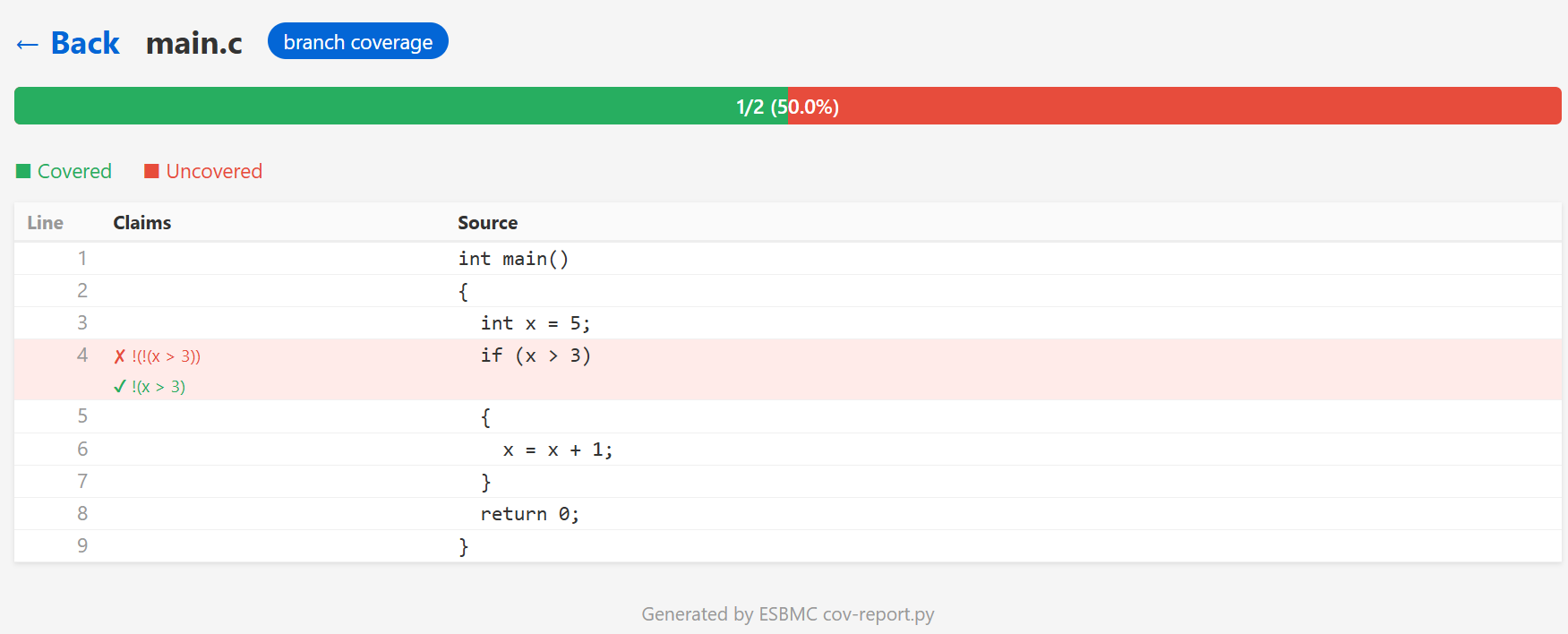
This script reads the JSON file produced by esbmc --cov-report-json and
generates an LCOV-style HTML report, including annotated source code and
per-file coverage summaries.