Overview
The Python frontend converts Python source files into ESBMC’s internal representation (IRep), enabling the engine’s bounded model checker and SMT backend to verify program properties.
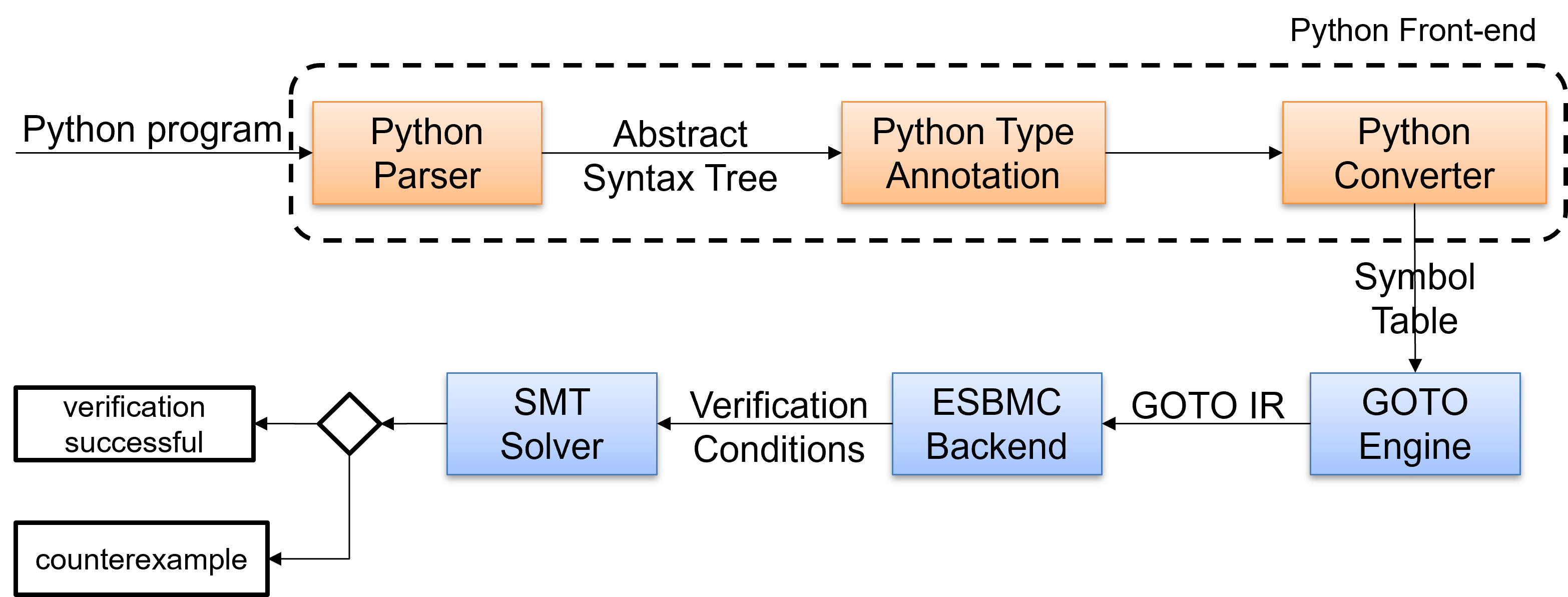
The pipeline has three stages: AST generation (Python) → type annotation (Python) → symbol table generation (C++). Each stage feeds into the next before ESBMC’s backend takes over.
AST Generation
Python code translation starts by parsing .py files into an Abstract Syntax Tree (AST). This is done using Python’s built-in ast module and the ast2json package, which serializes the AST to JSON. The process runs alongside the Python interpreter and produces a JSON file for each .py file processed, including any imported modules.
This approach’s main advantage is that it relies on a native Python module, ensuring the parsed representation faithfully reflects the language.
The parser is implemented as the src/python-frontend/parser/ package. ESBMC invokes its parser/__main__.py entrypoint with a Python 3 interpreter; module discovery, cycle detection, and relative-import rewriting live in parser/import_resolver.py, which emits structured diagnostics on missing modules and cyclic imports.
Type Annotation
After generating the AST, the frontend traverses the JSON tree and inserts additional nodes carrying type information. PEP 484 introduced an optional type system, allowing developers to annotate variables using the var_name: type syntax.
Where explicit annotations are absent, the frontend infers types from constants, previously annotated variables, binary expressions, and class instances.
The JSON below shows the annotated representation of x: int = 10:
{
    "_type": "AnnAssign",
    "annotation": {
        "_type": "Name",
        "id": "int"
    },
    "target": {
        "_type": "Name",
        "id": "x"
    },
    "value": {
        "_type": "Constant",
        "value": 10
    }
}
Symbol Table Generation
The final frontend step converts the annotated JSON AST into a symbol table using ESBMC’s C++ IRep API. This API builds a control-flow graph (CFG) from the program, modelling assignments, expressions, conditionals, loops, functions, and classes. The result is stored in a context structure that feeds into ESBMC’s GOTO conversion process.
Operational models
The Python operational models — the int/str/list/dict behaviour, the
math and random models, the exception hierarchy — are precompiled to a
GOTO binary at build time, the way c2goto builds the C library. ESBMC used
to re-convert them from AST JSON, and then lower the same 113 function bodies,
on every run. A trivial verification dropped from 3.26 s to 1.80 s and the
Python regression suite from 2952 s to 1932 s
(#7747,
#7778).
Two further costs went with it: a module’s AST is parsed on its first lookup
rather than for every *.json in the parser’s output directory at startup
(#7777), and model functions the
program cannot reach are dropped before GOTO conversion, so a program that
reaches 4 of them no longer lowers 383
(#7780).
Two consequences worth knowing. Models reached through an import stay on the
source path, so a user module of that name can still shadow them. And --ir
falls back to converting from source, because the precompiled models are built
at one integer width.
Backend: Symbolic Execution and SMT
Once the frontend produces the GOTO program, ESBMC’s backend performs symbolic execution, generating instructions in Single Static Assignment (SSA) form. These are then encoded as first-order logical formulas and discharged by an SMT solver (Bitwuzla by default; Z3, MathSAT, and others are also supported).